
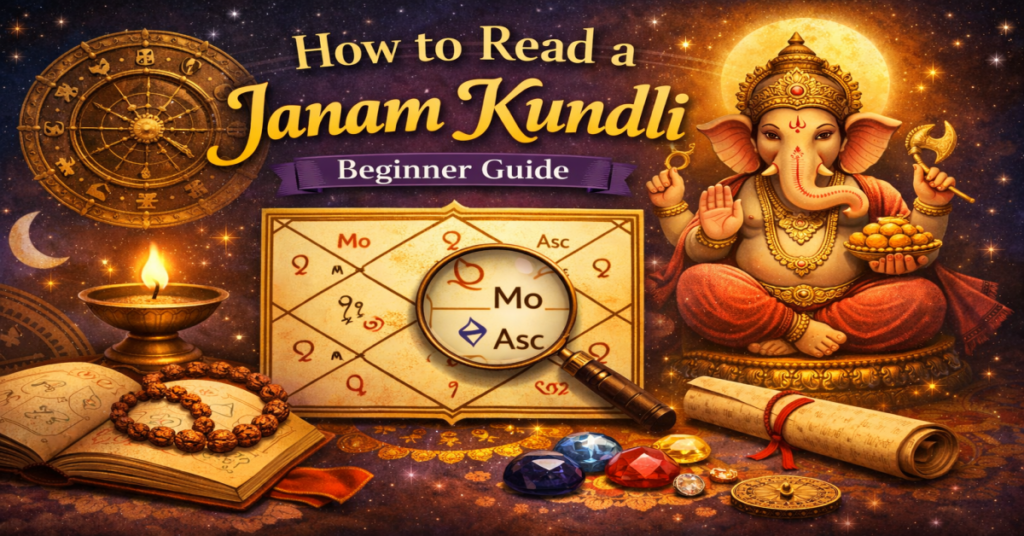
How to Read Janam Kundli: A Beginner’s Guide to Understanding Your Life Map
How to Read Janam Kundli: A Step-by-Step Beginner’s Guide (2026)
Ever wondered “Kundli kaise padhe?” Learn how to read janam kundli with this simple birth chart reading guide. Understand houses, signs, and planets like a pro!
Have you ever looked at that square diagram with all those crisscrossing lines and numbers and felt like you were trying to solve a high-level math problem? You aren’t alone. In India, a Janam Kundli is more than just a piece of paper; it’s considered a “blueprint” of your life.
Many people ask, “Kundli kaise padhe?” (How do I read my Kundli?) thinking they need to be a scholar to understand it. The truth is, once you understand the basic building blocks, reading your birth chart is like reading a map of your own personality and destiny.
In this birth chart reading guide, we will break down the complex symbols into simple English. Whether you want to understand your career, your relationships, or just your own quirks, this guide is your first step.
What is a Janam Kundli? (The Janam Kundli Meaning)
Before we jump into the “how-to,” let’s talk about the “what.”
A Janam Kundli is essentially a snapshot of the sky at the exact moment you were born. Imagine someone standing at your birth location, looking up, and taking a 360-degree panoramic photo of the planets.
In astrology birth chart basics, we believe that the positions of these planets influence your character, your challenges, and your opportunities.
- The Houses: These are the different areas of your life (Career, Family, Money).
- The Signs: These are the “flavors” or “styles” of energy.
- The Planets: These are the “actors” who play a role in your life.
Step 1: Understanding the Houses (The 12 Bhavas)
The most important thing to know about a North Indian Kundli (the square style) is that the houses are fixed. When you look at the chart, the top-center diamond is always the 1st House. From there, you count counter-clockwise. Even if the numbers inside the boxes change, the boxes themselves always represent the same area of life.
The 12 Houses and What They Represent:
| House | Name in Hindi | What it Covers |
| 1st | Tanu Bhava | Your personality, physical body, and appearance. (The Lagna) |
| 2nd | Dhan Bhava | Wealth, family, and the way you speak. |
| 3rd | Sahaj Bhava | Younger siblings, courage, and short travels. |
| 4th | Sukh Bhava | Mother, home, comfort, and vehicles. |
| 5th | Putra Bhava | Children, creativity, education, and romance. |
| 6th | Ari Bhava | Enemies, health, debt, and daily hard work. |
| 7th | Yuvati Bhava | Marriage, life partner, and business partnerships. |
| 8th | Randhra Bhava | Longevity, sudden changes, and hidden things. |
| 9th | Dharma Bhava | Luck (Bhagya), father, and long-distance travel. |
| 10th | Karma Bhava | Career, fame, profession, and status. |
| 11th | Labha Bhava | Gains, income, and your social circle. |
| 12th | Vyaya Bhava | Expenses, spiritual growth, and foreign lands. |
Step 2: The Numbers in the Houses (The 12 Rashis)
One of the biggest mistakes beginners make is thinking the numbers in the boxes are the house numbers. They are not!
The numbers you see (1 through 12) represent the Zodiac Signs (Rashis). For example, if you see the number “5” in the 1st house, it doesn’t mean it’s the fifth house. It means your 1st house is ruled by Leo.
The Zodiac Sign Guide:
- Aries (Mesha): Energetic, bold, and impulsive.
- Taurus (Vrishabha): Stable, hardworking, and loves luxury.
- Gemini (Mithuna): Talkative, curious, and dual-natured.
- Cancer (Karka): Emotional, nurturing, and home-loving.
- Leo (Simha): Royal, confident, and a natural leader.
- Virgo (Kanya): Analytical, detailed, and helpful.
- Libra (Tula): Balanced, artistic, and relationship-oriented.
- Scorpio (Vrischika): Intense, mysterious, and strong-willed.
- Sagittarius (Dhanu): Philosophical, adventurous, and honest.
- Capricorn (Makar): Disciplined, ambitious, and practical.
- Aquarius (Kumbh): Original, humanitarian, and intellectual.
- Pisces (Meena): Spiritual, imaginative, and sensitive.

Step 3: Meet the Planets (The Grahas)
Now that you have the “rooms” (houses) and the “flavors” (signs), you need the “actors.” These are the planets sitting in those houses.
In Vedic astrology, we look at 9 main “planets”:
- Sun (Surya): Your soul, ego, and father.
- Moon (Chandra): Your mind, emotions, and mother.
- Mars (Mangal): Your energy, courage, and siblings.
- Mercury (Budh): Your logic, communication, and business sense.
- Jupiter (Guru): Your wisdom, luck, and children.
- Venus (Shukra): Your love life, luxury, and art.
- Saturn (Shani): Your discipline, karma, and hard work.
- Rahu: Obsession, foreign things, and future goals.
- Ketu: Detachment, past life, and spirituality.
How to Read Your Kundli – Putting it All Together
Let’s try a simple example. Suppose you look at your 10th House (the bottom-right diamond from the top).
- See the number: If the number written there is 10, your career house is ruled by Capricorn. This suggests you are very disciplined in your work.
- See the planet: If Jupiter (Gu) is sitting in that house, it means you might have a career in teaching, law, or consulting.
- Combine them: You are a disciplined (Capricorn) professional who uses wisdom (Jupiter) to grow in your career (10th house).
The Importance of the Ascendant (Lagna)
The first house is called the Ascendant or Lagna. This is the most important part of your chart. It represents YOU.
Whatever sign is in the first house becomes your “Lagna Rashi.” If you have a number “1” in the top diamond, you are an Aries Ascendant. This sign sets the “vibe” for your entire life journey.
Common Questions (FAQs)
1. Which Rashi is more important: Moon or Sun?
In Indian astrology, the Moon Sign is usually more important because it rules your emotions and your daily life. However, your Lagna (Ascendant) is what defines your physical reality.
2. Can I read my Kundli without a birth time?
You can get a general idea, but it won’t be accurate. Without the time, we don’t know which sign was rising on the horizon, which means we can’t place the houses correctly.
3. What does “Exalted” and “Debilitated” mean?
Every planet has a “favorite” sign where it feels strongest (Exalted) and a sign where it feels weak or uncomfortable (Debilitated). For example, the Sun is exalted in Aries—it feels powerful there!
4. Why are there so many different charts?
The main chart is the D-1 (Lagna Chart). As you learn more, you’ll see other charts like the D-9 (Navamsha) which is used to look deeper into marriage and spiritual strength. For beginners, just stick to the D-1.
Conclusion: Your Kundli is a Conversation
Learning how to read janam kundli isn’t about predicting every single second of your life. It’s about understanding your natural strengths so you can use them, and recognizing your weaknesses so you can work on them.
Don’t worry if you don’t get it all on the first day. Start by identifying your Lagna and looking at where your Moon is sitting. Once you get comfortable with those, the rest of the chart will start “talking” to you.
Ready to see your own map?
Open your birth chart and try to find which sign is in your 1st house. That’s your first step toward self-discovery!